
WELCOME BONUS 300%
UP TO €2000 + 100
FREE SPINS
UP TO €2000 + 100
FREE SPINS
Home → Blackjack
Blackjack at 888Starz: Variants, Rules and Payouts
Live stream with three cameras and OCR
Infinite Blackjack utilizes a live dealer format provided by Evolution, offering betting limits ranging from 1 to 5,000 EUR for serious players. The game streams with high-definition video quality that supports real-time card recognition for transparent gameplay verification. This setup ensures that every shuffle and deal is visible to the participant without digital alteration.
Quantum Blackjack Plus Live from Playtech introduces Quantum Multipliers up to 1,000x on specific three-card combinations totaling 21 points. This feature modifies standard payout structures by adding random multipliers to winning hands during the live session. Players can experience significantly higher variance compared to standard table games due to these unpredictable boosts.
Blackjack Party hosted by Evolution creates a lively atmosphere with two moderators guiding the game flow between 1.00 and 1,000 EUR bets. The stream includes four side bets: Any Pair, 21+3, Hot 3, and Bust It, which are distinct from the main hand wager. These additional wagers increase the total amount risked per round beyond the primary blackjack stake.
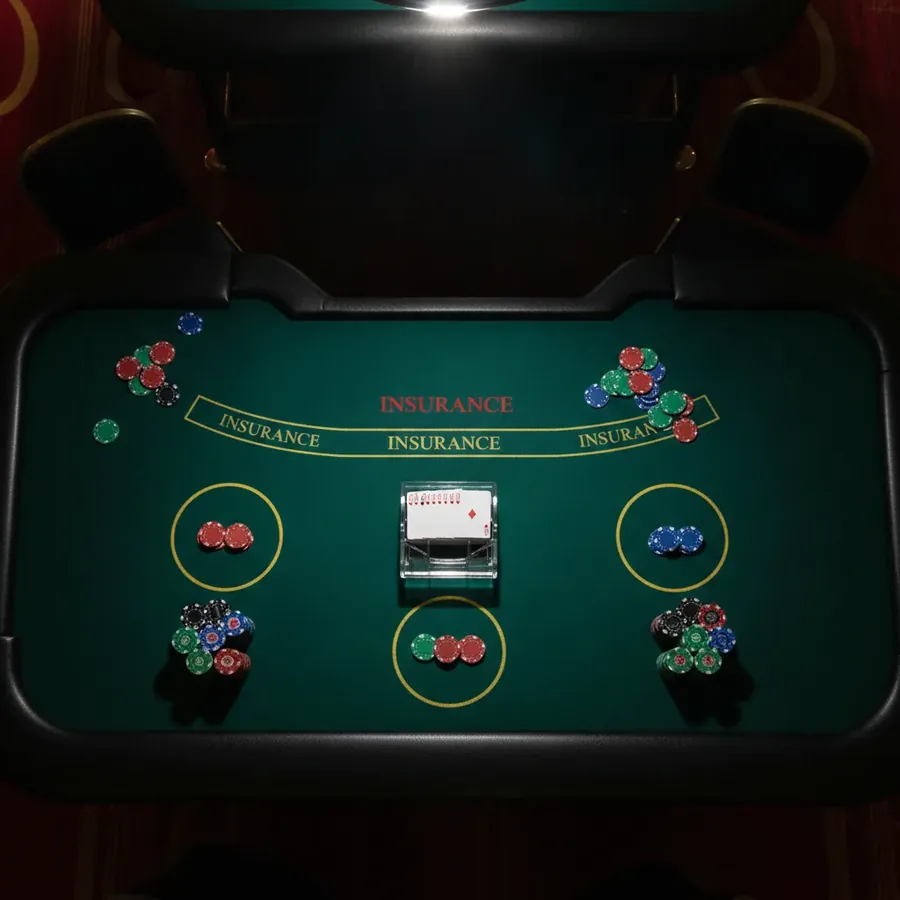
Error insurance: 7 percent additional house edge
Insurance is a separate side bet available when the dealer shows an Ace, paying out at 2:1 if the dealer has blackjack. The theoretical return to player (RTP) for this specific wager stands at 92.53%, resulting in a substantial house edge of 7.47%. Accepting this bet significantly increases the overall cost of play compared to declining it consistently.
Basisstrategie advises players to always decline Insurance unless they are counting cards with a True Count greater than or equal to +3. For a single-deck game, the disadvantage rises to approximately 5.88% even under optimal counting conditions. Most casual players lack the skills to overcome this mathematical disadvantage through card counting techniques.
The presence of multiple decks, typically six to eight, further dilutes the effectiveness of any potential card counting strategy. Each additional deck makes tracking the ratio of high to low cards more difficult and less profitable over time. Consequently, the 7.47% house edge remains a persistent drain on the bankroll for the average participant.
Bonus conditions often exclude Blackjack completely
Tischspiele contribute only 10% towards the bonus turnover requirement, whereas Slots contribute 100% to the same target. This means that for every 100 EUR wagered on Blackjack, only 10 EUR counts toward clearing the wagering conditions. Players must wager ten times more on table games to achieve the same progress as slot players.
The 300% welcome bonus up to €2,000 plus 100 free spins requires significant volume to convert into withdrawable cash via table games. A 100 EUR deposit yields a 300 EUR bonus, but meeting the rollover through Blackjack demands 3,000 EUR in actual bets just for the bonus portion. This volume is exceptionally high given the low contribution rate of 10%.
Many operators explicitly exclude Blackjack variants entirely from bonus eligibility, forcing players to use slots for conversion. Even when allowed, the slow progression makes the bonus practically unusable for dedicated blackjack enthusiasts. The financial incentive structure heavily favors high-variance slot machines over low-edge table games.
How long do 100 EUR last at a 1 EUR table?
At a minimum bet of 1 EUR per hand, a 100 EUR bankroll allows for exactly 100 initial hands before complete depletion without any wins. If the player loses every single hand consecutively, the funds vanish after one hundred rounds of play. This baseline assumes no doubling down or splitting, which would alter the consumption rate of the bankroll.
Standard deviation of 1.15 for Liberal Vegas Strip rules indicates moderate volatility affecting the duration of play. With an RTP of 99.72%, the expected loss per hour depends on the speed of the game and number of hands dealt. Slower pace tables extend the lifespan of the 100 EUR budget by reducing the hourly bet volume.
Late Surrender rules allow players to forfeit half their bet when facing a strong dealer upcard, preserving some capital. This rule improves the RTP by approximately 0.08 percentage points, slightly extending the viability of the 100 EUR stack. Strategic adherence to surrender options can delay bankruptcy compared to playing all hands to completion.
Seat change at the Live Table in 20 seconds
Infinite Blackjack offers unlimited seats at the virtual table, allowing immediate access without waiting for a physical chair to open. New players can join the ongoing round within seconds, integrating directly into the current game state. This flexibility removes the friction of waiting for a spot at crowded online casino tables.
Playtech's Quantum Blackjack Plus also supports rapid entry with betting limits from 1 to 5,000 EUR for diverse stake levels. The system processes new bets instantly, ensuring that late arrivals do not miss critical dealing phases. Participants benefit from a seamless transition between different tables or sessions without technical delays.
Evolution's Blackjack Party maintains a consistent flow despite variable player numbers, accommodating quick seat changes efficiently. The two moderators manage the game pace to ensure fairness for both new joiners and long-term regulars. This operational efficiency minimizes downtime and keeps the gaming environment active around the clock.
Blackjack variants at a glance
| Variant | Payout | House edge | Rule | Bet range |
|---|---|---|---|---|
| Blackjack Auszahlung 6:5 statt 3:2 (6 Decks) | 98.15% | 1.85% | Ersatz von 3:2 durch 6:5 fügt exakt +1.39 Prozentpunkte zum Vorteil des Casinos hinzu – stärker als jede andere Regeländerung. Bei $10 Einsatz zahlt Blackjack $12 statt $15. | Blackjack 6:5, Gewinn 1:1 |
| Blackjack Split / Double / H17 – Regel-Effekte | n.a. (Regel-Modifikatoren) | H17 +0.22 Prozentpunkte; RSA −0.08 Prozentpunkte; DAS −0.14 Prozentpunkte | Dealer Hits Soft 17 verschlechtert RTP um 0.22 Prozentpunkte; Resplit Aces verbessert um 0.08 Prozentpunkte; Double After Split verbessert um ca. 0.14 Prozentpunkte; 6 Decks statt 8 – ca. 0.02 Prozentpunkte. | Double – Einsatz ×2 mit einer Karte; Split – bis 4 Hände; Ass-Split meist mit einer Karte. |
| Blackjack 6 Decks, S17, DAS, DOA, Auszahlung 3:2, Basisstrategie | 99.54% | 0.46% | Dealer steht auf Soft 17; Verdopplung auf jeder Zweierkarte; Verdopplung nach Split erlaubt; keine Aufgabe. Basisstrategie ist für diesen Wert zwingend | Blackjack 3:2, normaler Gewinn 1:1, Insurance 2:1 |
| Blackjack Insurance / Versicherung (6–8 Decks) | 92.53% | 7.47% | Separate Nebenwette bis 50% der Hauptwette, wenn der Dealer ein Ass hat. Basisstrategie schreibt IMMER Ablehnung vor (außer Karten zählen bei True Count ≥ +3). Bei einem Deck Vorteil ≈ 5.88% | Insurance 2:1 |
| Blackjack Surrender (Late Surrender) – Regel-Effekt | n.a. (Regel-Modifikator) | −0.08 Prozentpunkte | Spieler gibt Hand nach Dealer-Blackjack-Prüfung auf, verliert die Hälfte des Einsatzes. Verbessert RTP um ca. 0.08 Prozentpunkte. Early Surrender ist wesentlich wertvoller (bis −0.6 Prozentpunkte), aber extrem selten. | Rückzahlung 50% des Einsatzes |
| Blackjack Ein Deck, klassische Regeln, 3:2 | 99.85% | 0.15% | Weniger Decks = niedrigerer Vorteil; ein Deck gibt ca. −0.48 Prozentpunkte gegenüber 8 Decks. Oft durch 6:5 Auszahlung kompensiert. | Blackjack 3:2, Gewinn 1:1 |
16 vs 10 played incorrectly: most common error
The dealer showing a ten forces the player to hold a hard sixteen, which triggers a specific statistical outcome in Blackjack Insurance / Versicherung games using six to eight decks. The house edge for this specific insurance side bet reaches 7.47%, significantly higher than the base game, because the probability of the dealer holding an ace is low. Players who fail to hit on sixteen when facing a ten increase their expected loss rate by ignoring the basic strategy that mandates hitting in this scenario. This mathematical reality holds true regardless of deck count variations.
Blackjack Auszahlung 6:5 instead of 3:2 adds exactly 1.39 percentage points to the house advantage, making the correct play on a sixteen even more critical for bankroll preservation. When a player hits and busts, they lose the entire wager, but standing guarantees a loss whenever the dealer completes a nineteen, twenty, or blackjack. The financial impact is stark: a $10 wager yields only $12 on a natural win under 6:5 rules, compared to $15 under standard 3:2 payouts. This disparity compounds the cost of every incorrect decision made at the table.
Infinite Blackjack from Evolution offers unlimited seats with bets ranging from one to five thousand euros, allowing players to practice these decisions without high pressure. The RTP of 99.47% assumes perfect basic strategy, meaning any deviation like standing on a hard sixteen against a ten directly reduces the theoretical return. Quantum Blackjack Plus Live from Playtech provides multipliers up to 1,000x, but these do not alter the fundamental probability of busting when hitting on sixteen. Adhering to the math remains the only way to mitigate the inherent house edge in these live environments.
Set session stop after 30 percent loss
Blackjack Ein Deck features a 0.15% house edge, which is approximately 0.48 percentage points lower than the 8-deck variant due to reduced card removal effects. If a player sets a strict limit to stop playing after losing 30 percent of their initial bankroll, they effectively cap their downside exposure during a negative variance streak. For example, starting with 100 euros means stopping after a 30 euro loss, preserving 70 euros for future sessions or other games. This discipline prevents the rapid depletion of funds that often occurs when chasing losses in high-volatility environments.
Live Table vs RNG Table dynamics influence how quickly a 30 percent loss threshold might be reached, as Infinite Blackjack allows bets up to five thousand euros per round. High-stakes players can deplete a small bankroll much faster at a live table compared to a standard RNG game with lower maximum limits. The speed of play at Evolution tables, combined with the potential for rapid multi-round sequences, demands stricter pre-defined loss limits to maintain control. Without such a boundary, the emotional response to losing can lead to irrational betting patterns that ignore the underlying mathematics.
Surrender rules provide a mechanical way to limit losses, as Late Surrender returns 50% of the wager after the dealer checks for blackjack. While Early Surrender is rarer and more valuable, reducing the house edge by up to 0.6 percentage points, Late Surrender still offers a modest improvement of 0.08 percentage points. Utilizing surrender on a hard sixteen against a dealer ten can be mathematically superior to hitting or standing, depending on the specific rule set. Combining surrender with a fixed percentage loss limit creates a robust framework for managing risk during any given session.
Live Table vs RNG Table: Speed and Limits
Infinite Blackjack operates at Evolution with a minimum bet of one euro and a maximum of five thousand euros, accommodating both casual players and high rollers. The presence of unlimited seats means that players never wait for a spot, unlike traditional casino floors where availability dictates access. This accessibility allows for continuous engagement with the game mechanics, including the four available side bets: Any Pair, 21+3, Hot 3, and Bust It. Each side bet carries its own distinct house edge, which must be calculated separately from the main game RTP of 99.47%.
Quantum Blackjack Plus Live from Playtech introduces quantum multipliers that can award up to 1,000x on three-card combinations totaling twenty-one points. These multipliers apply to the main bet and side bets, creating significant volatility spikes that are absent in standard RNG versions. The game supports bets between one and five thousand euros, matching the high limits found in other premium live dealer offerings. However, the RTP of 99.57% is achieved only when employing optimal strategy alongside these multiplier events, requiring precise decision-making.
Blackjack Party by Evolution differs significantly by focusing on atmosphere rather than high-speed action, featuring two moderators to enhance the entertainment value. The betting range is more modest, spanning from one euro to one thousand euros, which naturally slows down the rate of bankroll fluctuation. This slower pace allows players to observe patterns and make calculated decisions without the pressure of rapid-fire rounds typical of infinite variants. The social element does not change the underlying probabilities, but it alters the psychological experience of playing the game over time.
Perfect Pairs vs 21+3 in House Edge
The 21+3 side bet combines the player's first two cards with the dealer's upcard to form a poker hand, paying out based on ranks like flushes or straights. In Infinite Blackjack, this bet is available alongside other options like Any Pair, Hot 3, and Bust It, each offering different risk-reward profiles. The house edge for 21+3 varies by casino but generally sits around 2-4%, significantly higher than the main game RTP of 99.47%. Players seeking to maximize their theoretical return should avoid this bet entirely, as it erodes the long-term value of every wager placed.
Perfect Pairs pays out when the player's first two cards are a pair, categorized as mixed, colored, or perfect pairs for increasing multipliers. Unlike 21+3, Perfect Pairs relies solely on the player's hand composition, independent of the dealer's upcard or subsequent draws. The payout structure typically offers 5:1 for mixed pairs, 10:1 for colored pairs, and 25:1 for perfect pairs, though exact odds depend on the number of decks used. This independence makes it a distinct proposition from 21+3, appealing to players who prefer betting on their own card distribution rather than combined poker hands.
Comparing the two reveals that 21+3 often has a slightly higher house edge than Perfect Pairs in many European jurisdictions, though specific values depend on the paytable. Both bets contribute minimally to the overall bonus turnover requirements, which stand at 10% for table games compared to 100% for slots. Wagering 100 euros on these side bets counts as only 10 euros toward the bonus clearance, making them inefficient for meeting rollover conditions. Players should prioritize the main game bets to clear bonuses faster while minimizing the impact of the elevated house edges on side wagers.
Surrender vs Playing Out on 16 vs 10
Late Surrender allows a player to forfeit half their bet after the dealer checks for blackjack, improving the RTP by approximately 0.08 percentage points. This rule modifier is particularly valuable when holding a hard sixteen against a dealer ten, where the probability of busting upon hitting is high. By surrendering, the player loses only fifty percent of the stake instead of risking the entire amount, which statistically preserves more capital over thousands of hands. This option is rare in online casinos but essential for maximizing the efficiency of every dollar wagered at the table.
When surrender is unavailable, the player must choose between hitting or standing on a hard sixteen against a dealer ten, both of which are negative expectation plays. Hitting carries the risk of busting immediately if the next card is seven or higher, while standing guarantees a loss unless the dealer also busts. The decision hinges on the specific deck composition and remaining cards, but basic strategy universally recommends hitting in most single or double-deck games. However, in six-deck games with S17 rules, the margin between hitting and standing becomes extremely narrow, favoring the hit slightly.
Resplitting Aces (RSA) and Doubling After Split (DAS) offer additional strategic depth that can offset some of the disadvantages of playing out difficult hands. DAS improves the RTP by about 0.14 percentage points, allowing players to double down on split hands for greater profit potential when the deck is favorable. Resplitting Aces adds another 0.08 percentage points to the player's advantage by permitting multiple splits of aces, which increases the frequency of strong final hands. These rule enhancements make the difference between merely surviving a tough spot and actively mitigating the house edge through optimal play.
Soft 17: Dealer Hits or Stands
The Blackjack Liberal Vegas Strip variant utilizes liberal rules including a dealer standing on Soft 17, which is the most favorable condition for players seeking optimal return rates. This specific rule configuration prevents the house edge from increasing by the 0.22 percentage points that occur when the dealer hits Soft 17 instead of standing firm. Consequently, this adjustment preserves the theoretical return to player rate at 99.72 percent, significantly higher than variants where the dealer must take an additional card on soft totals.
Dealer Hits Soft 17 introduces a mathematical disadvantage of plus 0.22 percentage points to the house edge, directly reducing the expected long-term return for any participant playing basic strategy. The standard deviation for this game remains at 1.15, indicating moderate volatility compared to other table games available on the platform during peak hours. Players who fail to recognize this rule difference may inadvertently accept a lower payout structure without realizing the immediate impact on their bankroll management over time.
The RSA rule allows resplitting aces, which improves the RTP by approximately 0.08 percentage points, offering a slight mathematical advantage that complements the Soft 17 standing rule effectively. This combination creates the lowest possible house edge of 0.28 percent among the listed variants, making it the statistically superior choice for serious analysts evaluating bonus wagering requirements. Each successful resplit doubles the opportunity for profit, provided the dealer does not hit soft seventeen and thereby invalidate the strategic advantage gained through precise rule selection.
Insurance vs Even Money on Own Blackjack
Blackjack Insurance is a separate side bet available when the dealer shows an ace, paying out at 2:1 odds if the dealer possesses a ten-value card underneath the exposed ace. This wager carries a steep house edge of 7.47 percent in six to eight deck games, making it one of the most unfavorable bets available to casual participants at the table. Basic strategy universally dictates always rejecting this insurance offer unless the player is actively counting cards with a true count greater than or equal to positive three.
The base game pays blackjack hands at 3:2, returning 150 euros for every 100 euros wagered, whereas accepting even money essentially converts this into a 1:1 payout guaranteed against a dealer tie. Rejecting insurance preserves the higher theoretical return of 99.85 percent found in single-deck games, while accepting it immediately drags the effective yield down toward the 92.53 percent seen in insurance-only scenarios. This mathematical reality ensures that consistent acceptance of even money erodes long-term profitability regardless of short-term variance or luck experienced during individual sessions.
Single-deck variations present a slightly better insurance scenario with a house edge of approximately 5.88 percent, yet still remain negative value propositions compared to simply declining the wager entirely. The payout structure of 2:1 for insurance fails to compensate for the probability frequency of the dealer holding a ten in standard shoe configurations used across most tables. Analytical models confirm that avoiding this side bet entirely maximizes the expected value per hand, aligning perfectly with the strict wagering contribution limits imposed by the operator.
When can you increase your bet?
Players may double their wager after receiving exactly two initial cards, a rule known as Double After Split, which improves the overall RTP by approximately 0.14 percentage points in favorable conditions. This flexibility allows strategic adjustment of risk exposure during specific hand compositions, particularly when the remaining deck composition favors high-value cards for the upcoming draw phase. The ability to double down on any two-card total significantly enhances the potential return compared to restricted variants that limit doubling options to only nine, ten, or eleven totals.
The DAS rule permits doubling down after splitting pairs, adding substantial strategic depth to multi-hand scenarios and contributing positively to the game's mathematical expectation for skilled participants. This feature is integral to achieving the 99.54 percent RTP associated with six-deck games featuring S17, DAS, and DOA rulesets, distinguishing them from more restrictive alternatives. Without this capability, the house edge would rise noticeably, reducing the efficiency of bonus turnover generation for players utilizing the welcome bonus funds on these specific tables.
Infinite Blackjack Live offers betting limits ranging from one euro to five thousand euros, allowing high rollers to scale their positions dynamically while benefiting from unlimited seating arrangements. Quantum Blackjack Plus Live incorporates quantum multipliers up to 1,000 times on three-card combinations totaling twenty-one points, introducing extreme volatility that drastically alters standard payout expectations. These live dealer formats require careful bankroll management due to the higher stakes involved, ensuring that the ten percent contribution toward bonus wagering remains mathematically sustainable over extended play periods.
How many decks are in the shoe?
Blackjack Ein Deck utilizes a single deck of cards, providing a house edge of just 0.15 percent and an RTP of 99.85 percent under classical rules with thirty-two-to-twenty payouts. Reducing the number of decks from eight to one lowers the house advantage by approximately zero point four eight percentage points, offering the best possible theoretical return for players. However, many casinos compensate for this mathematical advantage by altering the blackjack payout from thirty-two-to-twenty down to sixty-five-to-forty, which drastically changes the economic landscape.
The transition from thirty-two-to-twenty to sixty-five-to-forty payouts adds exactly 1.39 percentage points to the house edge, resulting in a much worse RTP of 98.15 percent for six-deck shoes. A ten-euro bet yields twelve euros instead of fifteen euros upon hitting a natural blackjack, demonstrating how subtle rule changes disproportionately impact long-term profitability for regular participants. This specific variation highlights the critical importance of verifying payout structures before committing significant capital, as the deck count alone does not guarantee favorable conditions for the player.
Surrender rules modify the baseline mathematics by allowing players to forfeit half their bet after the dealer checks for blackjack, improving the RTP by approximately 0.08 percentage points effectively. Late surrender is far more common than early surrender, which can improve returns by up to 0.60 percentage points but is extremely rare in modern online implementations. Understanding these nuanced interactions between deck count, payout ratios, and surrender options is essential for calculating the true cost of playing and optimizing bonus utilization strategies.
Highroller from 500 EUR per hand
High roller tables often impose minimum bets starting at five hundred euros per hand, catering exclusively to players with substantial bankrolls capable of absorbing significant variance during intense gaming sessions. Infinite Blackjack Live accommodates wagers up to five thousand euros, providing ample room for aggressive betting strategies while maintaining an RTP of 99.47 percent for strategic players. This elevated threshold ensures that the ten percent contribution toward bonus wagering requirements remains financially viable for operators while offering high-stakes participants access to exclusive live dealer environments.
Quantum Blackjack Plus Live also supports maximum bets of five thousand euros, integrating random multipliers up to one thousand times that can dramatically inflate potential payouts on winning twenty-one-point hands. The presence of these massive multipliers introduces extreme volatility, meaning that standard bankroll management techniques must be adjusted to account for the possibility of rapid equity swings during play. Players engaging with these high-limit tables must carefully monitor their remaining bonus balance to ensure compliance with wagering terms while pursuing substantial wins from volatile multiplier events.
Table games contribute only ten percent toward fulfilling the wagering requirements for the three hundred percent welcome bonus up to two thousand euros, making high-stakes play inefficient for clearing bonus funds quickly. A fifty-euro bet on a slot machine contributes fully to the turnover target, whereas the same amount at a blackjack table only counts as five euros toward the required total. High rollers must therefore calculate the exact cost of clearing the bonus using table games versus slots to determine whether the entertainment value justifies the slower progression toward withdrawable cash status.
Contact
Live - online chat
Banking









Providers












888Starz 2026